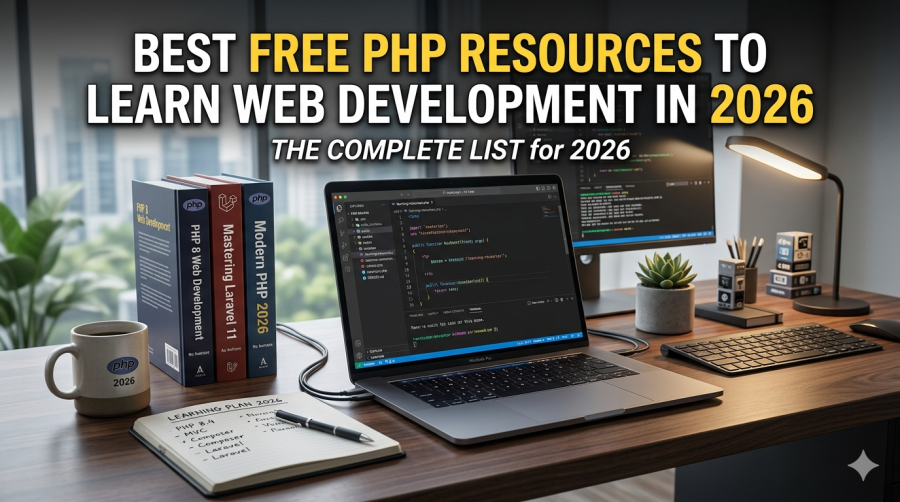
Best Free PHP Resources to Learn Web Development in 2026 — The Complete List
PHP powers 43.4% of all websites on the internet in 2026, including every WordPress site, every Magento store, and thousands of custom management systems built by developers who learned entirely from free resources. This guide compiles every genuinely useful free PHP resource available in 2026 — from the official PHP Manual to YouTube channels with millions of subscribers — along with a specific learning progression that takes you from writing your first echo statement to deploying a complete Laravel application without spending a single dollar.
The PHP learning ecosystem in 2026 is richer with free content than at any point in the language’s 30-year history. PHP 8.4, released November 2024, brought property hooks, asymmetric visibility, and a range of quality-of-life improvements that make modern PHP genuinely enjoyable to write. Laravel 11, Symfony 7, and a thriving ecosystem of packages make PHP one of the most productive backend ecosystems available. And the people who built these tools have invested enormous effort in free documentation, tutorials, and community support that any learner can access at zero cost.
The challenge for PHP learners in 2026 is not finding free content. It is navigating the enormous volume of PHP tutorials that teach outdated practices — PHP 5 patterns, procedural code without OOP, mysql_ functions that have been deprecated for a decade, and security practices that create vulnerabilities rather than preventing them. This guide specifically identifies the resources that teach modern PHP 8.x practices and filters out the legacy content that would teach you habits you will have to unlearn.
Why Modern PHP is Worth Learning From Scratch — The Case Against “PHP is Dead”
Before reviewing the specific resources, it is worth establishing what modern PHP actually looks like in 2026, because the most damaging misconception new learners encounter is that PHP is a legacy language being replaced by JavaScript or Python. This is incorrect both technically and commercially. Understanding the real state of PHP in 2026 affects what resources you choose and how seriously you pursue the language.
PHP 8.x (8.0 through 8.4) represents a complete transformation from the PHP 5/7 era that earned the language its bad reputation. The modern PHP feature set includes named arguments, constructor property promotion, fibers for async programming, enums, readonly properties, first-class callable syntax, intersection types, the match expression, and property hooks (introduced in PHP 8.4). A developer who last used PHP in 2015 would barely recognise the language today.
Laravel 11, the dominant PHP framework with over 79,000 GitHub stars, is regarded by developers across all languages as one of the most elegantly designed web frameworks in existence. Its documentation is among the best of any framework in any language. Its ecosystem — including Livewire for real-time UI without writing JavaScript, Filament for admin panels, and Cashier for subscription billing — makes building complete SaaS applications accessible to a single developer in weeks rather than months.
The commercial reality reinforces the technical picture. With 43.4% of all websites running PHP and 70,000+ active US job postings on Indeed alone, learning PHP in 2026 is learning a skill with enormous immediate employment opportunities. The narrative that PHP is dying has been disproven by market data every year since at least 2013. In 2026, PHP’s market share has increased slightly year over year.
The 3 Things Every PHP Learner Needs to Avoid in 2026
1. Tutorials teaching mysql_ functions. The mysql_ extension was deprecated in PHP 5.5 (2013) and removed in PHP 7.0 (2015). Any tutorial that shows you mysql_connect(), mysql_query(), or mysql_fetch_array() is teaching code that will not run on any modern server. These functions also have no prepared statement support, making every application built with them vulnerable to SQL injection. If a tutorial shows mysql_ functions, close it and find something newer. Use MySQLi with prepared statements or PDO.
2. Procedural PHP without OOP concepts. Modern PHP development, particularly with frameworks like Laravel and Symfony, is entirely object-oriented. A learner who only knows procedural PHP will be able to build simple scripts but will find Laravel completely opaque. Start learning PHP classes, objects, inheritance, and interfaces from your first month — not as an advanced topic after years of procedural code.
3. Mixing PHP and HTML excessively. Early PHP tutorials commonly show PHP logic and HTML interleaved in the same file, with PHP opening and closing tags scattered throughout HTML documents. This pattern makes code unmaintainable at scale and is inconsistent with how professional PHP is written. Learn to separate concerns from the beginning: PHP for logic, HTML templates for presentation, even in simple applications. Laravel’s Blade templating engine reinforces this separation automatically.
The Complete Free PHP Resource Library — Reviewed and Rated
The PHP Manual at php.net/manual is the authoritative reference for every aspect of the PHP language. It is maintained by the PHP community with contributions from the core PHP team and documents every built-in function, language construct, class, interface, and extension with examples, parameter descriptions, and user-contributed notes that often explain edge cases and common mistakes better than the official content itself.
Learning to use the PHP Manual effectively from your first week of PHP development is one of the most valuable habits you can build. Professional PHP developers open the manual daily — not because they have forgotten how functions work, but because PHP’s function library is too large to memorise and the manual’s examples are reliably accurate. A student who habitually checks the manual rather than guessing or relying on outdated Stack Overflow answers will write more accurate PHP from month one.
The manual’s language reference section covers the full PHP syntax including types, variables, constants, operators, control structures, functions, classes and objects, namespaces, enumerations, fibers, and exceptions. These sections are not beginner tutorials — they are comprehensive, technically precise documentation. Use them as your reference while building projects, not as your initial learning material. The user-contributed notes section beneath each function page is particularly valuable because experienced PHP developers frequently share real-world usage examples and warn about non-obvious behaviour.
How to use it: Bookmark php.net and use it as your first reference when you encounter an unfamiliar function or PHP feature. The search box at the top of the site accepts function names, class names, and language concepts. When you use any built-in function, look it up in the manual to understand all its parameters, return values, and possible failure modes — not just the happy path that tutorials show.
PHP The Right Way is a community-maintained guide that covers the modern PHP best practices that the official manual documents but does not opinionatedly recommend. Where the PHP Manual tells you how PHP works, PHP The Right Way tells you how PHP should be used in professional, production-quality code. It covers Composer for dependency management, coding style standards (PSR-12), security best practices, testing with PHPUnit, databases with PDO, templating, internationalisation, error handling, and virtual environments for development.
Reading PHP The Right Way cover to cover takes approximately 8 to 12 hours and is one of the most time-efficient PHP education investments available anywhere. The guide is written by experienced PHP developers who have strong opinions about what constitutes good PHP code, and they back those opinions with clear reasoning. After completing this guide, you will be able to identify bad PHP practices when you encounter them in tutorials or legacy codebases — a skill that is directly relevant to every PHP developer job because maintaining and modernising legacy code is a core part of most PHP developer roles.
The section on Composer is particularly important. Composer is the PHP package manager that modern PHP development depends on entirely. Understanding how to create a composer.json file, how to require packages, how to use autoloading, and how to understand semantic versioning is essential before learning any PHP framework. Laravel is installed via Composer. Symfony is installed via Composer. Every professional PHP project uses Composer. PHP The Right Way explains Composer clearly and practically.
Recommended reading order: Read the Getting Started and Coding Style sections in your first week of PHP learning. Return to the Dependency Management (Composer), Security, Databases, and Testing sections as you progress through your first project. Re-read the entire guide after 3 to 4 months of PHP development — the concepts that felt abstract initially will make complete sense once you have built with PHP.
Laracasts released “30 Days to Learn Laravel” as a completely free series in 2024, and it remains one of the best free resources for learning the Laravel framework available anywhere. Taught by Jeffrey Way, the founder of Laracasts and one of the most respected PHP educators in the world, the series covers the complete foundation of Laravel 11 development: routing, controllers, Blade templates, Eloquent ORM, database migrations, form handling, authentication, middleware, and deployment. Each lesson is focused, well-paced, and builds on the previous ones to produce a complete working application by day 30.
The production quality of Laracasts videos is the highest of any free PHP resource. Jeffrey Way’s teaching style is clear, opinionated in the best possible way (he consistently explains not just what to do but why), and focused on professional practices rather than the shortcuts that make tutorial code work but production code fail. After the 30-day series, the Laracasts free tier also includes several other complete series including introductions to testing with PHPUnit, Livewire basics, and Eloquent ORM deep dives.
To access the free tier content including “30 Days to Learn Laravel,” create a free Laracasts account at laracasts.com. The free content is clearly labelled in the catalogue. No credit card is required for the free tier. The paid subscription ($9 to $14/month) unlocks the full catalogue of 2,000+ lessons — worth considering after you have exhausted the free content if Laravel becomes your primary focus, as the paid content is genuinely exceptional.
Prerequisites for this series: You should understand PHP variables, arrays, functions, and basic OOP (classes and objects) before starting this series. If you are a complete PHP beginner, spend 4 to 6 weeks on PHP fundamentals first using learn-php.org or Codecademy’s PHP introduction. This series assumes you can write basic PHP and focuses entirely on how Laravel structures and extends that knowledge.
learn-php.org is a free interactive PHP tutorial platform that runs PHP code directly in the browser, eliminating the need to install XAMPP or any local development environment in the first days of learning. This is a genuinely valuable feature for absolute PHP beginners because the XAMPP installation and configuration process, while not technically complex, is enough friction to cause many people to give up before writing their first PHP line.
The platform covers PHP variables, data types, control structures, functions, arrays, strings, and object-oriented programming basics through interactive exercises where you write PHP code in a browser editor, run it, and see the output immediately. The exercises are self-graded and progress logically from simple variable declarations through to multi-step programming challenges. The entire platform is free with no account required to start, and no credit card information is ever requested.
The appropriate use of learn-php.org is as a 2 to 4 week starting point before transitioning to a local development environment with XAMPP or WAMP and the Codezips project library. Once you have written your first 50 to 100 PHP statements in the browser environment and feel comfortable with the basic syntax, install XAMPP on your computer and immediately begin building a real PHP project. The browser environment is an on-ramp, not a destination.
Recommended sequence: Use learn-php.org for weeks 1 to 3 (basics through OOP introduction), then install XAMPP, download a Codezips project, get it running locally, and begin extending it with new features. Never spend more than 4 weeks in the browser environment — real PHP development happens in a local or cloud environment, not a browser sandbox.
The official Laravel documentation at laravel.com/docs is widely regarded as the best framework documentation in any programming language — not just PHP but any language. Taylor Otwell, Laravel’s creator, has always prioritised documentation quality alongside code quality, and the Laravel team maintains the docs to the same standard as the framework code itself. Every feature is documented with clear explanations, practical code examples, and cross-references to related functionality.
Learning to use the Laravel documentation as your primary reference is a critical skill for any PHP developer using the framework. The documentation covers every aspect of Laravel including routing, middleware, controllers, request handling, responses, views with Blade, URL generation, sessions, validation, error handling, logging, Artisan CLI, broadcasting, cache, collections, contracts, events, file storage, mail, notifications, packages, queues, task scheduling, testing, and deployment. This is comprehensive enough that many Laravel developers work for years without needing any resource beyond the documentation and the Laracasts free tier.
The “Getting Started” section of the Laravel docs includes an installation guide, configuration walkthrough, and directory structure explanation that together give you everything you need to start a new Laravel project. The “Eloquent: Getting Started” section is the best free resource for learning Laravel’s ORM, which is one of the most elegant database abstraction layers in any language.
How to use it: After completing the Laracasts “30 Days to Learn Laravel” series, use the official documentation as your primary reference for every question that arises. The search functionality is excellent — type any Laravel concept and find the relevant page instantly. For most Laravel questions, the official documentation is more accurate and more current than Stack Overflow answers, which may refer to older Laravel versions.
Traversy Media is one of the largest and most trusted web development YouTube channels in the world with 2.3 million subscribers. Brad Traversy’s teaching style is clear, practical, and project-focused. His PHP crash course covers the complete PHP fundamentals in approximately 5 hours — variables, data types, control structures, functions, arrays, OOP, and database integration with MySQLi. His Laravel crash courses cover the framework fundamentals in 3 to 4 hour sessions. All content is completely free on YouTube.
The Traversy Media PHP OOP crash course is particularly recommended for students who have learned procedural PHP basics and are struggling to understand how classes and objects work. Brad’s practical examples — building a user system with classes rather than standalone functions — make the benefits of OOP immediately clear in a way that abstract explanations do not. This video consistently receives positive feedback from students who found OOP confusing in other resources.
One important note about using YouTube PHP tutorials in 2026: always check the upload date before investing time in a tutorial. PHP development practices evolve quickly and a tutorial from 2018 may teach mysql_ functions, PHP 5 syntax, or security practices that are outdated. Brad’s more recent PHP content (2022 onward) teaches modern PHP 8.x practices. Filter YouTube search results by upload date to find current tutorials.
Codezips provides free PHP project source code downloads that represent one of the most underutilised learning strategies in PHP education: studying and extending working production-style code. The project library includes hospital management systems, school management systems, ISP management systems, inventory management, employee management, student result management, and many more complete PHP and MySQL applications. Each project includes the complete source code, database SQL file, and typically a project report.
The learning value of the Codezips projects is not primarily in downloading and running them — it is in reading the code systematically and understanding how a complete PHP application is structured. Opening a hospital management system project and reading through the login.php, includes/db.php, admin/patients.php, and admin/appointments.php files gives you immediate exposure to real-world patterns: database connection handling, session management, prepared statements, SQL queries, form processing, and file organisation. This exposure compresses months of trial and error into days of structured code reading.
The extension strategy is where the real learning happens. After running a Codezips project locally and understanding its code, identify one feature that the project does not have and build it. Add appointment booking to a hospital management system. Add automated billing to an ISP management system. Add PDF report generation to a student management system. Each extension forces you to write original PHP code in the context of a working application, which is exactly what professional PHP development looks like. The completed extension then becomes a portfolio piece: you can honestly describe building an appointment booking module for a hospital management system using PHP and MySQL, which is a much more impressive portfolio item than a generic tutorial CRUD app.
How to use Codezips projects in your learning: After your first 4 to 6 weeks of PHP basics, download one project that interests you. Set it up locally on XAMPP. Spend 2 to 3 days reading every file systematically and commenting what each section does. Then pick one specific feature to add. Write it yourself before looking at how similar features are implemented in the existing code. Deploy your extended version to InfinityFree (free PHP hosting) and write a case study README for the GitHub repository.
The Best Free PHP YouTube Channels in 2026
Free PHP and Laravel Community Resources
| Community | Platform | Best For | Activity Level | Beginner Friendly |
|---|---|---|---|---|
| Laravel.io Community | Forum | Laravel-specific questions and code review | Very Active | Yes |
| r/PHP on Reddit | PHP news, career advice, and broad PHP questions | Very Active | Somewhat | |
| r/laravel on Reddit | Laravel questions, package recommendations, career | Very Active | Yes | |
| PHP subreddit Discord | Discord | Real-time PHP help and community interaction | Moderate | Yes |
| Laravel Discord (official) | Discord | Real-time Laravel help from experienced developers | Very Active | Yes |
| Stack Overflow (PHP tag) | Q&A | Specific technical PHP questions with verified answers | Very Active | Filter by date |
| PHP.net Community | Mailing lists | PHP internals discussions and RFC tracking | Moderate | Advanced users |
| Spatie GitHub | GitHub | Professional PHP package source code to study | Very Active | Intermediate+ |
Your 12-Month Free PHP Learning Path
8 Real PHP Projects to Build From Free Resources
PHP Skill Tracker — Where Are You on the Learning Path?
🐘 PHP Developer Skill Tracker — Tick What You Have Learned
Frequently Asked Questions
Is it possible to learn PHP to a professional level entirely for free in 2026?
Yes. The combination of the official PHP Manual, PHP The Right Way, learn-php.org, Laracasts’ “30 Days to Learn Laravel” series (free), the official Laravel documentation, Traversy Media and Program With Gio on YouTube, the Codezips project library, and the Laravel and PHP community forums provides a complete, professional-level PHP education at zero cost. The only costs you cannot fully avoid are optional: GitHub Foundations certification ($49), a custom domain name ($10 to $15 per year), and potentially a paid hosting tier if InfinityFree’s free tier limitations become constraining. The educational content itself is entirely free.
Should I start with plain PHP or go straight to Laravel?
Start with plain PHP for at least 4 to 6 weeks before touching Laravel. This is the strongest consensus among professional PHP developers who teach others. Laravel is an abstraction layer on top of PHP — to understand what it is abstracting and why, you need to first know what PHP does without the framework. A student who starts with Laravel without PHP fundamentals will write Laravel code without understanding it, copy solutions from Stack Overflow without knowing if they are correct or secure, and be unable to debug problems that occur below the framework layer. The 4 to 6 weeks of PHP fundamentals first is not a detour from your Laravel goal — it is the foundation that makes your Laravel learning dramatically faster and more effective.
How do I know when my PHP is good enough to start applying for jobs?
You are ready to start applying when: (1) You have at least two deployed PHP projects with live URLs that you can walk through in an interview. (2) You can write a user authentication system from scratch without referring to any tutorial. (3) You can explain what SQL injection is and demonstrate how prepared statements prevent it. (4) You understand the difference between GET and POST, when to use each, and why forms that modify data should use POST. (5) You can set up a new project from scratch and know which files to create and why. These five criteria correspond directly to the questions asked in most junior PHP developer interviews. You do not need to be an expert in all of PHP — you need to know the fundamentals well enough to discuss them clearly and build from them confidently.
Are the Codezips PHP projects good quality to learn from?
The Codezips projects are real-world PHP and MySQL applications that demonstrate practical web development patterns — authentication, CRUD operations, database relationships, form handling, and session management. They are appropriate starting points for understanding how a PHP application is structured and for extension practice. Like any real-world codebase built over time, individual files may use different coding styles, and some older projects may use patterns that modern PHP would implement differently. The appropriate way to use them is as study material and extension targets, not as templates to copy. When you extend a Codezips project, you will encounter places where you would have made different decisions — making those decisions and documenting them is itself a valuable learning exercise.
What are the most important PHP security concepts to learn before applying for jobs?
In order of frequency in junior PHP developer interviews: (1) SQL injection prevention through prepared statements — be able to explain what it is, demonstrate both a vulnerable query and a safe prepared statement, and explain why the prepared statement is safe. (2) Password hashing with password_hash() and password_verify() — never store plaintext or MD5/SHA1 hashed passwords, always use bcrypt or Argon2 via PHP’s password hashing functions. (3) Cross-Site Request Forgery (CSRF) protection — understand what it is, how it works, and how to implement a CSRF token in a form. (4) Cross-Site Scripting (XSS) prevention through htmlspecialchars() when outputting user data in HTML. (5) Session security — understand session fixation, session hijacking, and basic session security practices. These five concepts are the security foundation that any professional PHP developer is expected to understand, and they come up in virtually every PHP developer technical interview.
The broader free learning landscape before you specialise in PHP
The full case for why PHP is a smart language investment
Where PHP fits in the full web developer career path
Start with real PHP code right now
Last updated April 27, 2026. PHP usage data from W3Techs April 2026. Salary data from ZipRecruiter April 2026. All resource URLs and free tier availability verified April 2026. Platform terms may change — verify before enrolling.